Squat Depth Solution for Athletes
How you can combine full squats with bands or chains
Among track and field world record holders I can find examples of ¼ squats, ½ squats, ¾ squats and full squats.
This can be a tricky area for young athletes to navigate.
Greater range has extra potential joint health and muscle benefits, but then you can’t lift as heavy, and heavier near the top can enhance peak speed and jumping ability.
My sport of basketball already overuses upper positions. Now factor in knee injuries, plus a modern chair-sitting society, and my strength BELOW THE GAME / BELOW THE CHAIR became unnaturally weak. Thus, improving my ability below the game/chair was the most life-changing thing I did - not because it was “better than” higher ranges but because lower ranges are where I was proportionally weakest.
However, I concurrently improved other basic human abilities like downhillstrength, which is a higher knee position, so throughout my ATG journey I was working on some degree of upper and lower positions.
Over 16 years of squat experiments, the style I have seen work best for my combined knee health and peak jump is using bands or chains on the bar so that it gets appropriately heavier as it goes up!
In the example below, the load is over 100 pounds heavier at the top than at the bottom (you can use a scale to see precisely for yourself, since the exact tension at the top would vary by band size, brand, your height, and how you set them up).
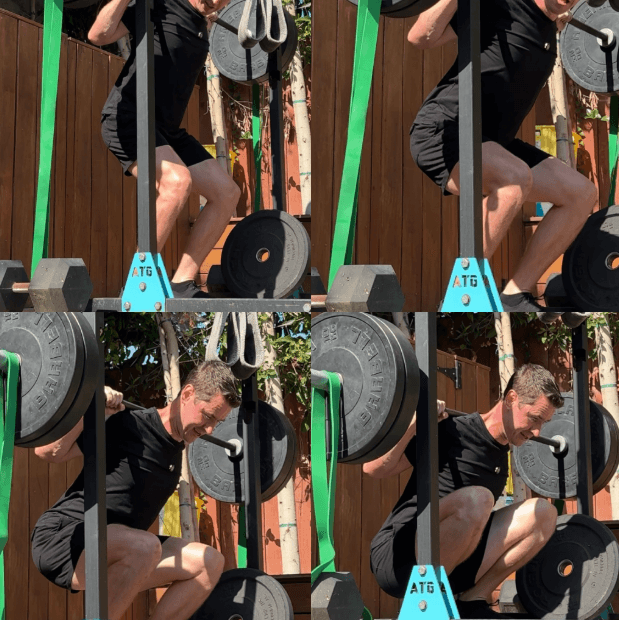
This allows me to get stronger in all my squat ranges at the same time.
Per my belief of adequate ability relative to your demands in life, increased squat strength would naturally warrant a need for: increased lower leg strength to keep up with your upper legs, increased hamstring (back of thigh) strength to keep up with the front of your thighs, increased lower back strength to keep up with your lower body, and increased hip flexor strength to pick up your legs. I’ve observed that putting those ingredients together with strategic practice of the sport has consistently created outlier speed and jump results.
Conclusion:
There’s much debate on squat depth for athletics.
There’s very little educational information stating the truth: ALL ranges have benefits.
There’s also very little educational information showing how you can combine full squats with bands or chains in order to get stronger through the entire range.
Therefore, I wanted to keep this week’s article short and simple.
I will leave you with a reminder that COUNTERBALANCE reduces knee pressure and provides you with a gradient scale to strengthen your deep squat to the level that feels right for you. Don’t be pressured by how deep you go, how heavy the load is, or how close the load is to your body.
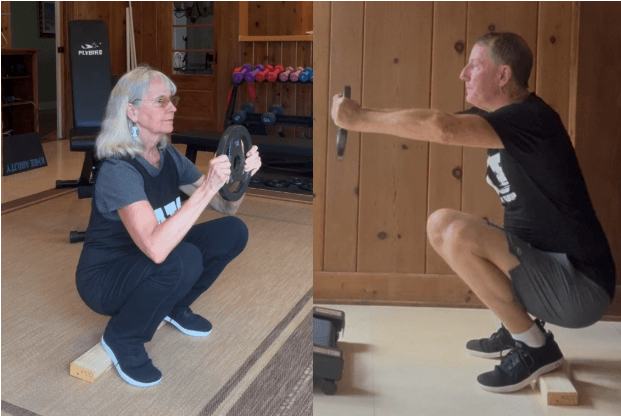
My parents are 69 and 72 and they use this counterbalance method to stay strong and mobile as grandparents.
Yours in Solutions,
Ben
For further help with my ATG Basics and Pro Sports programs: atgonlinecoaching.com
To see if there’s an ATG coach or gym near you: map.atgforcoaches.com
Sign up for free knowledge
We send out new articles weekly.