How to Get Your Parents Winning with the Lower Body
What I’ve done successfully with my parents (69 and 72)
I’m about to share what I’ve done successfully with my parents - age 69 and 72 - and add a broader viewpoint on each step, to help prevent bias and give you more options:
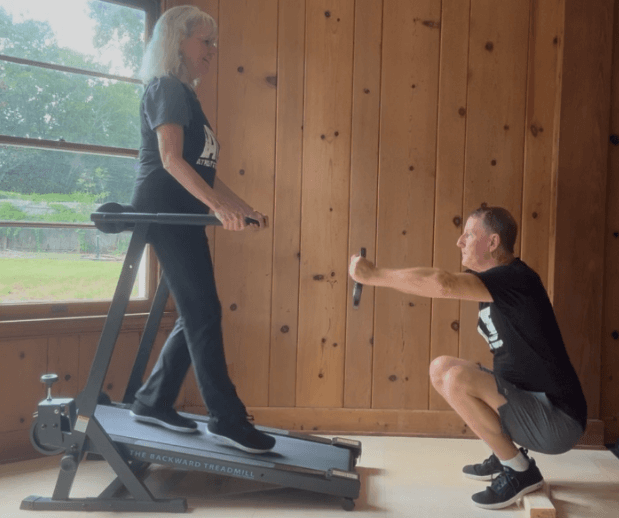
#1: Joint-friendly cardio that STRENGTHENS
My parents didn’t get hooked on ATG until they started sledding.
Then it made sense.
Within a few minutes the lungs are huffing and puffing. The quads are burning. But the KNEES and LOWER BACK are not hurting.
I know of no method which does more for longevity in such a short time and so safely.
PAIN and TIME are barriers which commonly deter people from exercise.
Sleds
Air Bikes
Rowers
Resisted Treadmills
I have seen each of these to be LIFE-CHANGING for longevity exercise because they are relatively enjoyable yet VIGOROUS.
As a stepping stone, my exercise included successfully self-rehabbing my knees for basketball by dragging a sled backward.
That influenced my use of sleds in my original ATG gym.
When Covid hit and the gym shut down, I was driven to develop a resisted backward treadmill for home use.
As you can see, I’m not advising against other resisted cardio methods.
I put my money where my mouth is. Last year when I was a volunteer high school coach, I donated not only my resisted treadmills but also air bikes and rowers for the school’s student and faculty gym space.
As I rebuild my local ATG gym next year, I’ll have an air bike, a rower, and a resisted treadmill.
Since my parents are moving to live in the same town with me, I don’t need to purchase more things for their current home gym, but if I did, I’d buy them an air bike and a rower immediately.
To be clear, I do not use air bikes and rowers myself, but I believe in this general product category strongly enough to ensure my family and trainees have options, even if that means rotating methods each workout to keep things fresh. I generally promote strength training 3 times per week, so you could even pick one of those methods per session.
All that being said, I WILL NOT LEAVE YOU BARRED BY PRICE. You have multiple ways to solve this:
Walking up a hill is free. This adds resistance. Go more briskly uphill but intentionally slower downhill, ensuring you are not working through pain. Take smaller steps if needed. Provided you don’t overdo things, the downhill can help STRENGTHEN your legs and knees.
If there are no hills near you, walking alone has a positive effect. You can also build excellent downhill ability with a $3 concrete block + a $5, 2”x4”x5’ board.
Lower on the board is easier.
Assisting from the bottom foot is easier.
Less reach is easier.
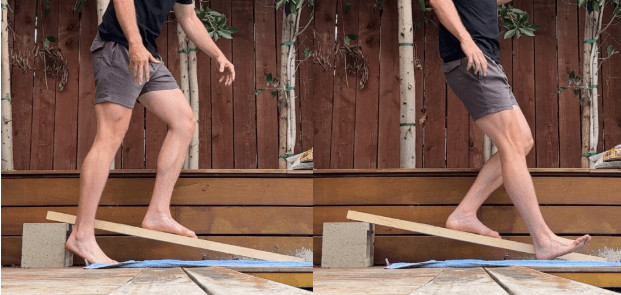
I have used this exercise to help the weakest knees I’ve seen, yet I’ve also used this same exercise to help some of the world’s most famous, explosive athletes experience less knee pain on the field.
Aim to ENJOY each stepdown session as you work your way over weeks-months-years to increased strength downhill.
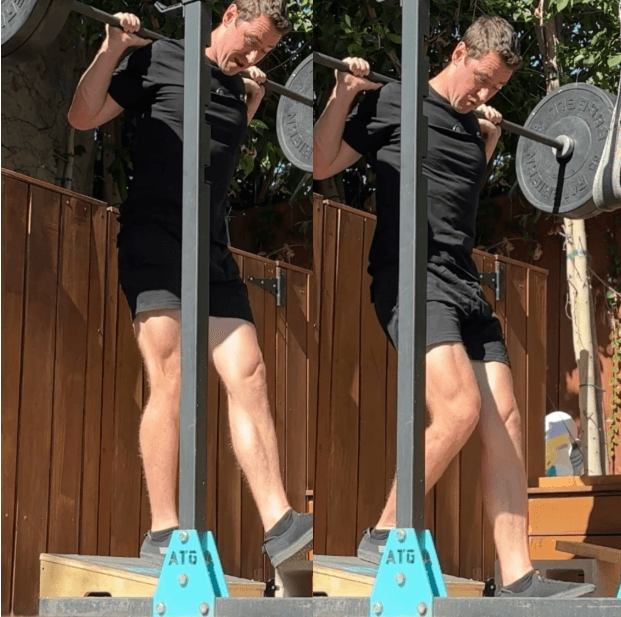
Note: It wouldn’t be crazy to have additional load going downhill, right? For extreme knee demands such as certain professional sports, I sometimes have clients build the ability to do the stepdowns with weight. That being said, don’t underestimate the benefit of seeking to master your own bodyweight for high repetitions.
#2: DEEPER ability
In youth we’ve got this naturally.
Over a lifetime we tend to lose it to some degree.
We rely on chairs, we tend to have some injuries, we tend to abuse our lower bodies in sports, and at a certain point, the human body naturally loses muscle as it ages.
For all of those reasons, I could actually argue that this step is THE most life-changing for older bodies!
The reason I listed resisted cardio first is because it’s less painful to start and it warms up the body for less pain in deeper positions.
The most fundamental exercise for a human body would be simply squatting down low.
Most people I coach feel best with some heel elevation and counterbalance. A $2, 2”x4” board usually works great to elevate the heels, and counterbalance directly reduces the actual pressure on your knees when you squat down, due to the basic law of leverage.
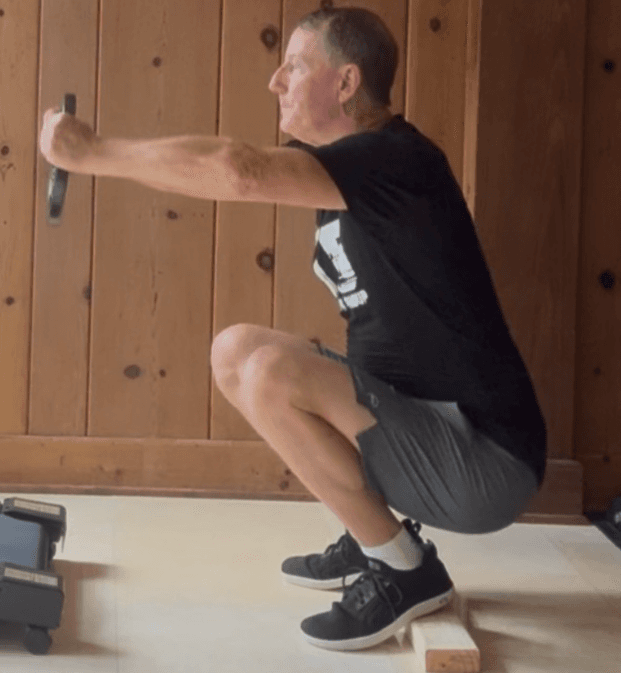
As such, the same amount of weight behind your back would be extremely difficult compared to having it in front of you. This truth supports a system which allows me to build strength to a sensible level for any client.
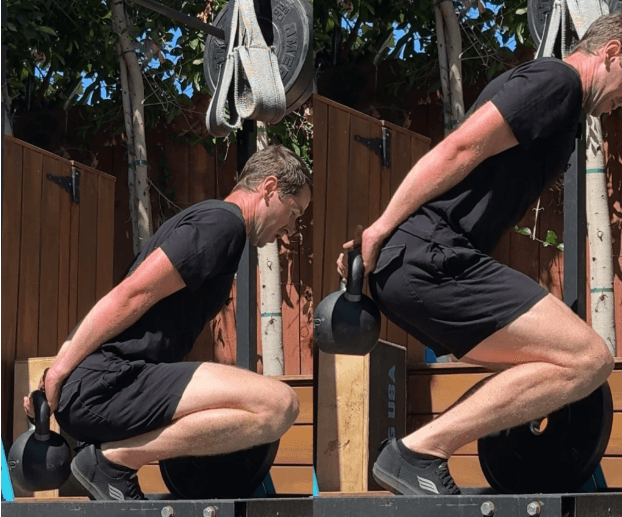
Like the resisted cardio strategy above, I’m trying to get results, but the method used must be enjoyed enough to not be abandoned!
How “right” are you about your training methods if you can’t get your parents to EXERCISE? Behind closed doors, this is a common issue competing trainers tell me they struggle with.
How “right” you are is borne out by your RESULTS in real life, not by theories.
Remember, the whole “no knees over toes” mandate was based on a theory that came out of universities. NO long term research had been done, but that theory directly prevented millions of people from strengthening through their natural range of motion!
For broader context, MANY methods can be successful for this deeper ability.
If you find SOME form of resisted cardio your parents enjoy, and SOME form of deeper ability they enjoy, you are doing a rare job as their child.
Life has no guarantees. It’s a game of Demand vs Ability and we can’t always control the Demand - but with these two categories, we can make our parents more capable with less pain and less likelihood of breaking down and needing assistance.
If for any reason this information doesn’t save you money long-term on babysitting, we have a 100% refund policy.
Yours in Solutions,
Ben
For further help with my ATG Basics and Pro Sports programs: atgonlinecoaching.com
To see if there’s an ATG coach or gym near you: map.atgforcoaches.com
Sign up for free knowledge
We send out new articles weekly.