Every Solution Counts: $9 Knee Rebuilding
How to rebuild and/or enhance a basic human ability
Stepdown progression, split squat mobility progression, and full squat strength progression are the three most helpful knee over toes movements I have coached over my 16 years. I started at age 19 helping myself, friends and clients with knee problems.
All can be done with a maximum of $9 in specialized equipment.
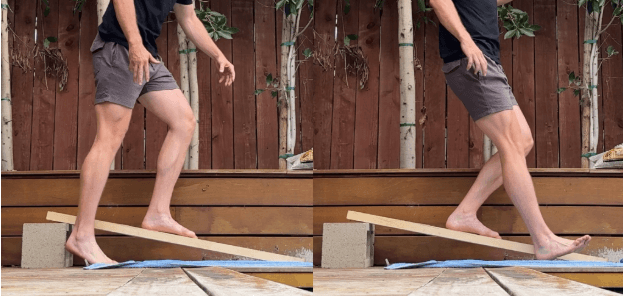
Stepping down is a basic human ability.
We have a smooth scale based on how far your off-leg is behind or in front of you, and how high you’re standing. If you’ve lost this pain-free ability, I want you to work at the level you can control down, without pain, enjoying every session on your way to greater protection than the norm. This is done over weeks, months, years of enjoyable workouts, in moderation.
No great time commitment is needed.
Simple but precise strategy is.
This is a $2 concrete block, with a $5, 2”x6”x5’ board - yet despite that minimum investment, I haven’t seen any exercise which is more basic and effective for knee demands in life!
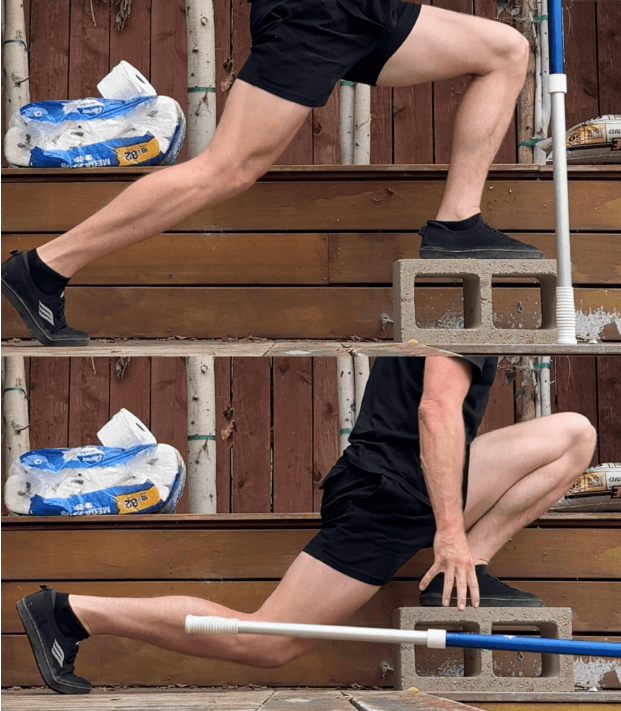
Split squat mobility adds further ankle and hip benefits, giving your knees greater freedom while strengthening your legs in the process.
This is the same $2 concrete block.
I grabbed a pool net and pole nearby. Every home already has a “mobility stick” in the form of a mop or broom.
You control the stretch and strength. Again, over weeks/months/years, with no great time commitment, you have a precision solution for better pain-free mobility than the norm.
A deep squat is the single best overall knee injury preventer I’ve seen over these 16 years and thousands of conversations with folks with knee injuries.
It is a basic human knee ability yet in modern life it is largely missing. The now-proven-false data of “no knee over toes” restricted this ability for the majority of college-educated exercise coaches and their millions of clients.
HOW STRONG is a very personal thing based on your demands in life.
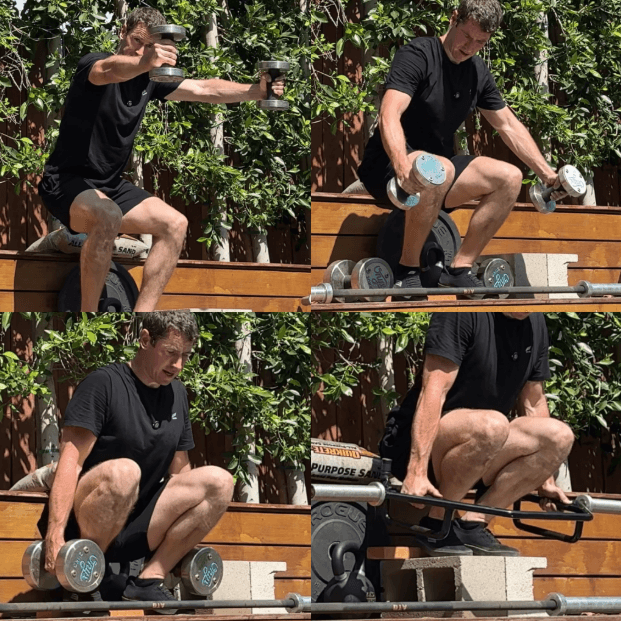
The strategy here is using enough heel elevation (a $2, 2”x4” works great for most) to exercise your natural full range of motion plus enough counterbalance to not have knee pain due to the pressure!
The simplest progression is using dumbbells to progress heavier and closer to the body. For extreme goals you could even add a second $2 concrete block and load as desired with a hex bar.
A more complicated but common option would be the same strategy of load and closeness progression but toward the upper body.
From plate, to dumbbell or kettlebell, to barbell on front or back, is accessible in any gym. It’s worth noting that for longevity goals, I think a $4 sandbag would work marvelously!
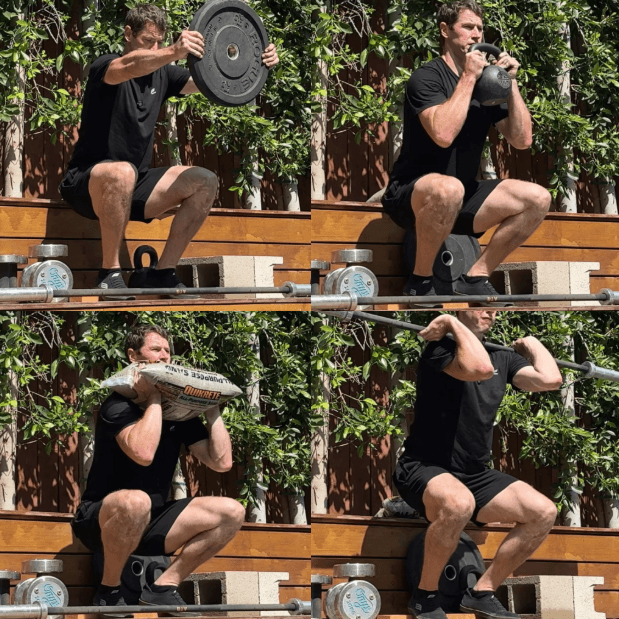
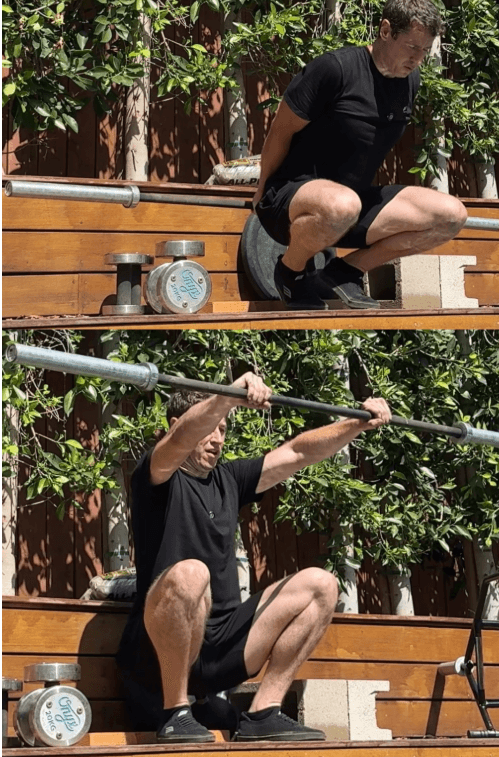
As further illustration to understand how strategic load position affects knee pressure, my average starting client would be in excruciating pain trying to full knee bend with a 45-pound bar behind the back. However, if the shoulders were strong enough to hold that same 45 pounds out in front of the body, the knee pressure would be low enough to not hurt:
This is one category of how to rebuild and/or enhance basic human ability.
Our bodies are in a game of Demand v Ability. What are our demands in life? What are our abilities to handle them? We have no guarantees, but my job is making you more aware of this game while increasing your skills in the ability department.
This article is not an end-all/be-all on the subject of the knee, since the body is connected. The lower legs, hamstrings and hips are also connected to overall knee function.
I have covered all basic zones recently, and will continue to do so, always seeking smoother progressions and accessibility for you.
Thank you for training with me.
Yours in Solutions,
Ben
For further ATG Basics program help ($19 to $99/mo) and the custom equipment I make for my coaching: ATGonlinecoaching.com
To see if I’ve certified an ATG coach near you: map.ATGforcoaches.com
Sign up for free knowledge
We send out new articles weekly.