BJJ ATG Gym + Knee & Back Recipes
How to set up a mini ATG in your BJJ Studio
Brazilian jiu jitsu has exploded onto the fitness scene. Stats show the number of BJJ gyms in North America going from roughly 500 to 10,000 over the past 10 years.
There are an estimated 5 million active BJJ practitioners around the world, and in surveys, the majority of them cite fitness as their primary motivation for starting.
Quite a few BJJ gym owners had such helpful results from ATG that they’re now ATG-certified coaches, or getting certified!
“How do you recommend setting up a mini ATG in my BJJ studio?”
After giving a detailed answer to this question for the third time in just a couple days, I realized I need to write this up with illustrations.
To be clear, I’m not a BJJ expert, but Charles Poliquin, the Olympic trainer who changed the trajectory of my knee and basketball life, wasn’t a basketball player!
The only sport Poliquin participated in was martial arts - so I guess the circle is coming back.
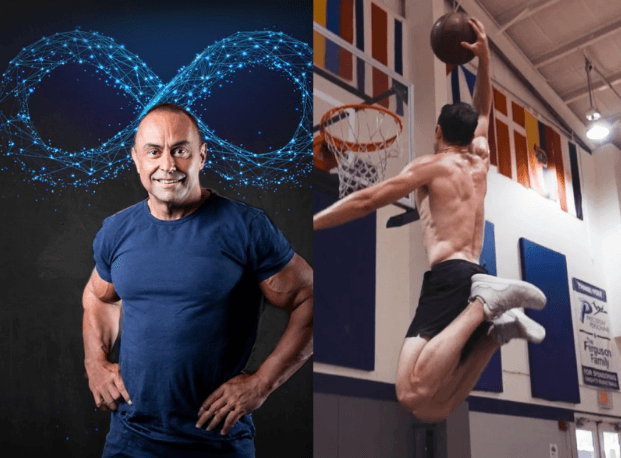
MINI ATG GYM DESIGN
I measured off 200 square feet (10’ x 20’), including ample walking space, and polished off my own mini ATG.
In fact, only 100 square feet of it is really needed for my ATG stuff, and the other 100 square feet is a basic bench, rack, bar, and weight plates.
The first (and biggest) space-saver for me is the concept of a personal hill.
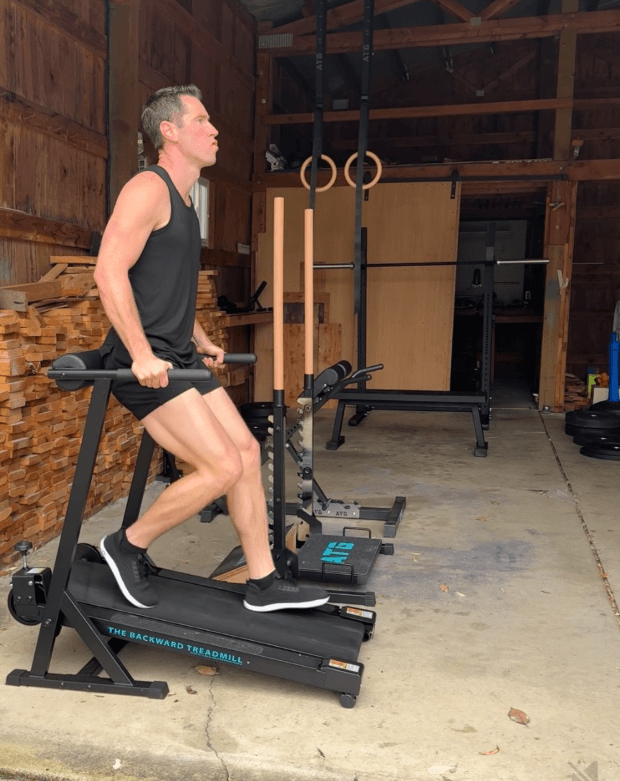
This allows me to get a smoking warm-up while supplying gentle strength and circulation for my knees.
This unit was a breakthrough in cost-effectiveness, less than half the price of any other resisted treadmill.
While continuing to make this version, we have an additional version coming out in 2026 so taller folks can get the feeling and results of forward hill running, too.
Forward and backward hill resistance has been my main cardio source for the past 3 years. On average I do 3 sets of 50 steps each forward and backward.
(I’m 6’1” but if I was any taller, this current unit would be limited for forward use.)
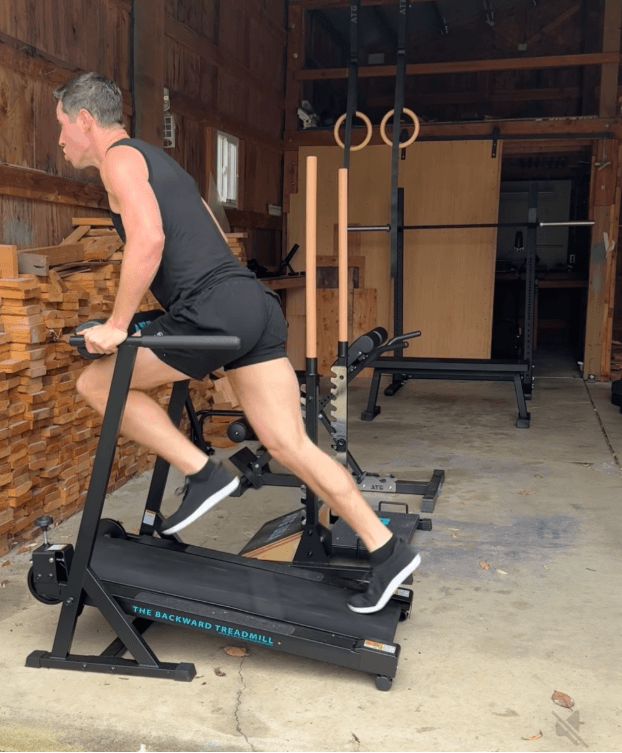
After that athletic, therapeutic, cardio-boosting warm-up, clients may need to catch their breath!
Our mobility box and slant are ideal for calf stretching and/or calf raises while the client “rests.”
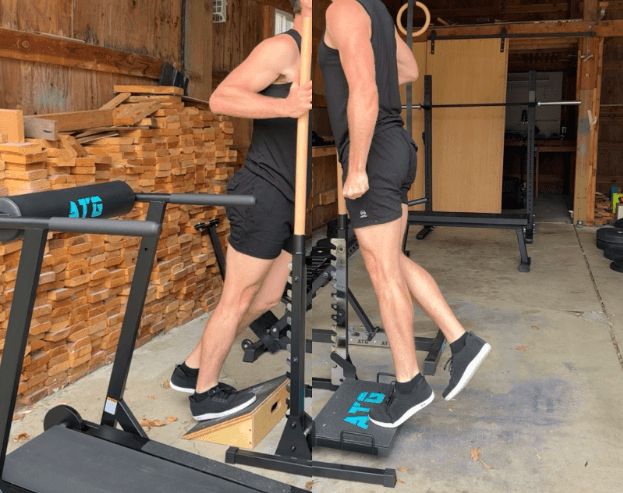
That ankle strength and mobility then flows right into knee and hip strength and mobility.
The mobility box allows smooth scalability…
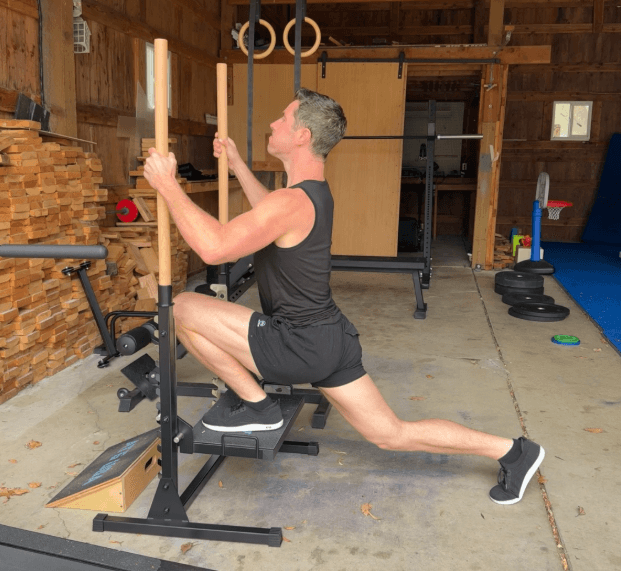
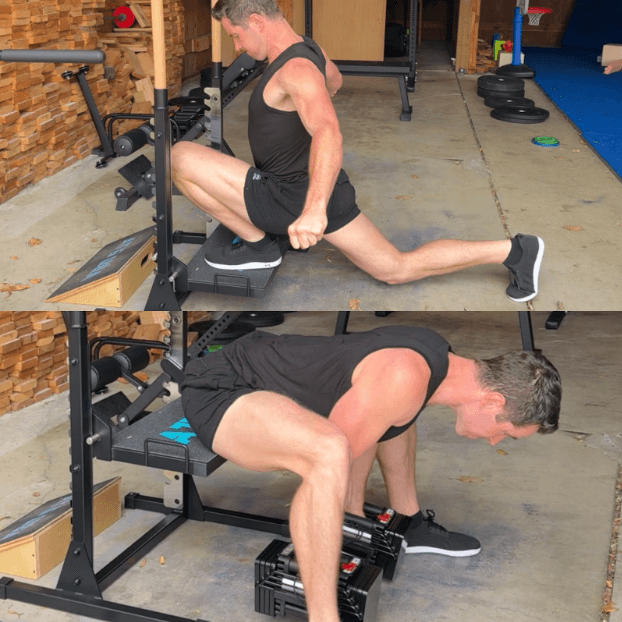
…and I believe this “stretch-strength” style of addressing ankles-knees-hips is the foundation of why I haven’t had a knee or lower back problem in over a decade, despite major problems prior, and significant demand upon my body year after year.
IMPORTANT NOTE FOR BJJ:
A 4-year-old is less likely to have a “bad back” than a 40-year-old.
However, a 4-year-old is not able to beat up a 40-year-old!
Youth = fewer “self” injuries but weaker vs the outside world.
Adulthood = more self injuries but stronger vs the outside world.
Then as you get even older, your risk of self and external injuries goes up!
This helps explain why strength through our mobility has been such a great protector of the body.
The problem is that in BJJ you have someone trying to hurt you.
Everything in this article could help, but I want to be extra clear:
ATG IS ONLY A SMALL PART OF WHAT WILL PROTECT YOU IN BJJ.
Your size, strength, and BJJ skills are all greater factors.
[I sincerely apologize if this segment was obvious and unnecessary for you. Unfortunately, I’ve had too many conversations with BJJers who believe their workouts alone can fully prevent injury in a fight!]
Onward…
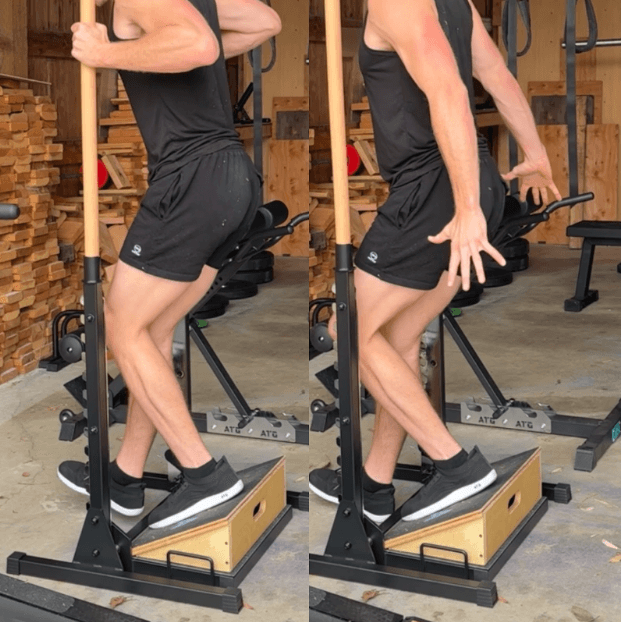
My all-time favorite knee pain helper works great from this same setup!
Then my all-time favorite low back helpers are easy to set up next in line:
What has served me well is thinking to build a natural “back brace” that can move.
This means above-average ability in the lower back, lower abs, and QLs (quadratus lumborum).
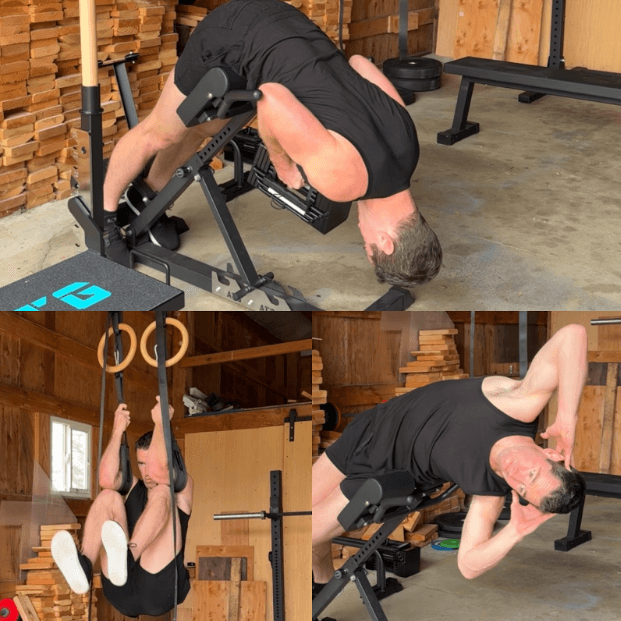
I believe this approach is still badly underrated for lower back health.
Additional exercises for specific purposes are then easy to fill in.
For example: I advise competitive BJJers to get stronger than normal behind the knee, and a ham roller can accomplish this task remarkably well for its small footprint.
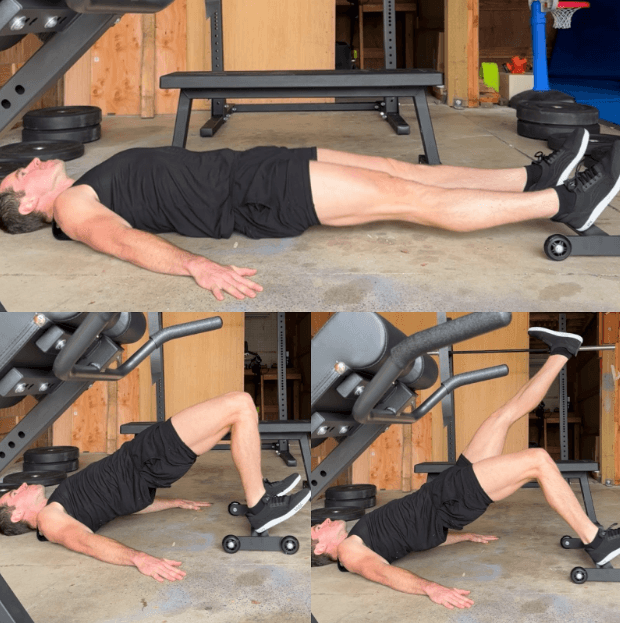
What we’ve covered so far can already be a workable lower body and core formula for life, and we’ve done so in just 100 square feet!
This leaves lots of room for other exercises or equipment you may want to add.
For example: Adding a tibialis bar takes virtually no room, and you can set up a client right from a regular weight bench:
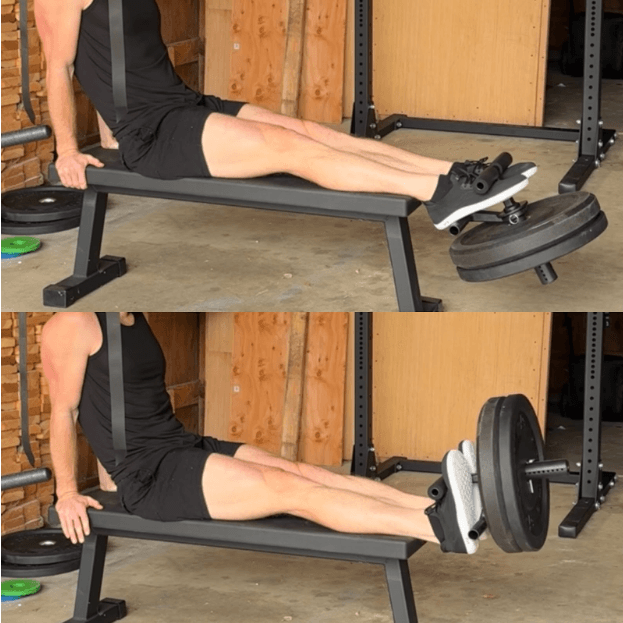
(Lower body is my specialty, but if you click here you can see an approach for shoulder resilience which the BJJ community has great results with.)
PERSONAL THEORY
The following is based on what I would want as a basketball player attending a basketball facility:
Identify the main physical barriers of the sport.
Set up protocols to help with the barriers, and have them in order, to the side of the court, so athletes can get a boost and stack up amazing long-term results with just 10 minutes of work while already warm from the sport work!
KNEE BOOSTING EXAMPLE
Backward hill 100 steps
Tibialis burnout
Calf raise burnout on each side
Slant step up burnout on each side
Ham roller 10 reps per side (or 20 reps if using two legs)
Full split squat 10 reps per side
This takes less than 10 minutes and could be done after 30-50 minutes of basketball skill work.
A second or third time through that circuit could be done for someone wanting even greater knee gains.
Thus, in 1 hour you could produce both basketball and knee results.
This is a win-win for your clients, and your profitability.
Without profits, passionate coaches often fail to help because the business flops and shuts down. With this approach, you can be saving your clients a lot of time and money!!
LOWER BACK & MOBILITY BOOSTING EXAMPLE
Tibialis burnout
Calf raise burnout on each side
Full split squat 10 reps per side
Seated dumbbell deadlift 10 reps
Back extension 20 reps
Hanging knee raise burnout
QL burnout on each side
This would again take only 10 minutes, while serving as a diagnostic.
Further sets can then be done based on the client’s weaker/stiffer areas.
Reminder: WE’RE EARLY
Just over 10 years ago, I was reading a college textbook with a giant X over a picture of someone squatting with knees over toes.
Today, research shows this was a mistake.
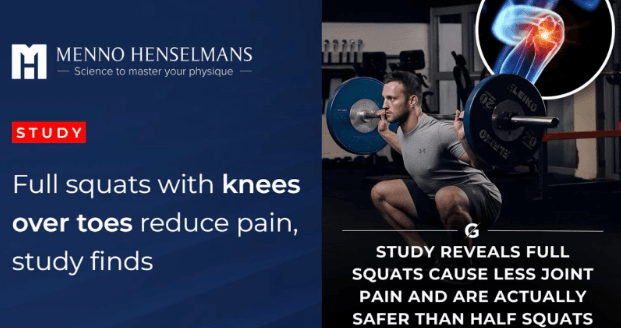
I don’t believe it was an intentional mistake, but nonetheless, that mistake cost us about 50 years of potential COMPETENCE and SOLUTIONS in terms of how to address the lower body (and even lower back!).
We’re making fast breakthroughs, but don’t assume you can’t contribute to this, and build beautiful systems that improve lives around you.
Please keep me posted.
Yours in Solutions,
Ben
ATG Online Coaching (Affordable access to all my programs, with form coaching so you eventually get each movement as I would help you get it in-person.)
Equipment, Shoes, & Shorts (Everything is on sale through the holidays, including our new USA-made gym shorts, which I’m wearing in this article!)
Sign up for free knowledge
We send out new articles weekly.